This post has been delayed for a couple of reasons, one of which should be evident from the text. I was also hoping to illustrate the words with three reproductions from the works of M C Escher. I applied to the M C Escher Co. (which apparently holds the copyright) for permission and had been awaiting a response. Permission, however, was eventually denied; “due to existing license-agreements”.
It is, of course, an interesting area in itself and one I’ve touched on before – an aspect of the commodification of human endeavour which can work both to incentivise but also to control and deny access. On this occasion the restriction is of little moment and I shall simply identify the relevant points. All the images are probably quite familiar and, for anyone interested, readily found on-line.
The latter two might both be considered iterations and developments of the “Penrose staircase”- a close relative of the “Penrose triangle”. That “impossible” figure, in fact, has a considerable provenance – most commonly first attributed to Oscar Reutersvärd in 1934 but continuing a tradition of ambiguities and perspectival incoherence stretching back through Hogarth, Piranesi and beyond the Renaissance.
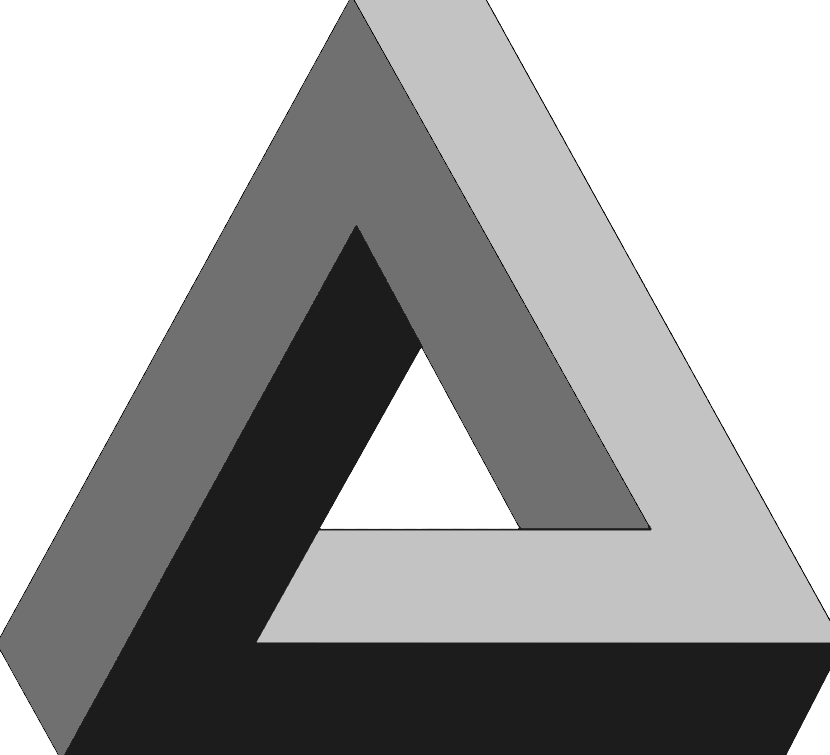
This image lies, I believe, in the public domain and is not subject to copyright constraints; although, interestingly, I understand the development of a set of digital instructions for a 3D print has given rise more recently to claims of a copyright infringement.
My purpose with the illustrations was simply to capture the elusive nature of a truth and to demonstrate the perilous futility of assembling apparently valid details, but with little regard for the coherence of the whole.
The post follows:
‘This statement is untrue’
An unembellished iteration of the “liar paradox”. The words enjoy a syntactical legitimacy but generate a semantic disquiet. Of itself, a valid utterance but, as with the drawing hands above, it’s the self-referential narrative that leads to a paradoxical disjuncture.
Now, I have no grounding in theories of logic, I can claim no formal insights to accommodate the unease. I’m just aware that the words and images, entirely sensible within their own disposition still contrive a denial of reason. They maintain a robust absurdity that would defy an infinity of improbabilities. They define their own demise and confound the reassuring certainties with an unsettling ambiguity.
Perhaps among the more familiar of Escher’s illustrations is the image of monks trudging endlessly up or down steps; but getting nowhere. Every tread, every riser leads legitimately and inexorably forward and up or down. But the totality of all that effort is not in the sum of the parts. The climbers end up where they started. The narrative finds us at a loss; delivered of a destination that seems to betray the fundamental tenets of sensible existence. Therein lies the disquiet.
In “Waterfall” the water flows from the base of the fall, through a series of channels, back to the head – and down the fall again. There’s an inherent dismay in confronting a series of apparently reasonable steps that usher in an untenable conclusion. As if one is parted from the anchoring certainties that hold us safe in a viable reality.
Some fifteen years ago I suffered a cerebellar stroke. After a stay in hospital I was sent home in a wheelchair and with a zimmer. Several months later I had recovered sufficiently to resume my life. Eventually I had the good fortune to regain a functional normality without significant impairment. A few weeks ago I found myself in A&E again, following an event which felt unpleasantly similar to the onset of that previous experience. I won’t speculate on the cause of this occurrence and any residual effects have been, thankfully, minimal. It was, however, a salutary reminder. The sense of reality in retreat – a growing and frightening realisation that something has gone very wrong.
On that first occasion, and over a period of about thirty minutes, I suffered a strangely changing and deteriorating sense of awareness accompanied with a gradual loss of any ability to do other than lie in a heap on the ground. My legs had turned to jelly! For several days then I didn’t open my eyes because I couldn’t make sense of anything I saw. Muscle control, balance and spatial awareness; all were gone. I still somehow knew myself but, for the moment at least, the world had been taken from me.
For months afterwards I would awake in the early hours with the certain and terrifying sense that only the merest chimera holds me from the brink; alone in a pervading darkness; the solid reality no more than an illusory assemblage of rational devices to see me through the void.
It’s a space that we populate with perceptions; discretely and intimately enmeshed within the machinery of logical thought. Indeed, logic describes the essential metric by which to know and navigate the conscious existence. Escher exposes the unreliable mechanisms. The strange loops, logical steps to an irrational destination, the figure and ground dilemmas – all the turning cogs and wheels which can exhibit such an apparent failure to engage.
The liar paradox has, in one form or another, quite a history; logicians, mathematicians and philosophers have all confronted the conundrum. And lacking their contextual insights I can do no better than any other empiricist in the street (never forgetting that the street is found in the mind) in addressing the challenge. Still, in exercising my uneducated introspection I found some encouragement in a claim by the logician and philosopher, Arthur Prior, that every statement includes an implicit assertion of its own truth. He develops his argument and seems to conclude that there need be no paradox. I’m in no position to comment on his reasoning.
However, I have long been troubled by the need to find myself an adequate justification for a belief in the fundamental and indispensable role of truth – in the sense of logical coherence. It seems that herein lies a solution. Sanity seems to reside in the sensible accommodation of a perceived reality – a product of experience and shared conformity, self and others, with agreed patterns of causality and conduct. Insanity lurks behind a denial of reason in a place that takes leave of the senses, a place that doesn’t compute.
Of necessity there are rules, structures. Untrue and meaningless statements contribute nothing, they’re the defective blocks that jeopardise the integrity of the whole. They have no validity. They undermine the ordered and vital illusion and deliver us to the chaos and darkness without. So, in this sense – recognising the invalidity of the statement – I too might dispense with the paradox.
Of course you don’t have to suffer a stroke to be cast loose. There’s no shortage of individuals more than ready to relieve you of any assurance that reason might prevail. For some there’s a perceived advantage to be won; for others, just a nice little fee. These individuals inhabit a territory peculiarly suited to those that would impose, exploit and dominate. The law, politics, media – all offer ample opportunity to tinker with the machine in the service of a competitive edge
But whether one’s stake in the world is confiscated through medical emergency or malicious connivance, for those beset by such misfortune, the consequences remain remarkably similar. A rudderless sense of dismay; nowhere to turn; disbelief turning to icy fear and despair. Total isolation in the void; all points of reference lost; a surrender of self.
Our survival, individually and as a species is inescapably bound within the reality we inhabit. It’s a reality built on the logical integrity of our perceptions and cognition. Those who dispense with truth undermine the foundation. They chip away at the branch on which we all perch, and when it breaks I fear that those who count on a divine safety net might well be disappointed. .
I believe I read somewhere that the artist noted the need to add a little water from time to time to compensate for any loss due to evaporation and to thus maintain the flow. . .
Perhaps there’s a word to describe the preoccupation with an arcane detail of a fabric that is otherwise fatally flawed?
I started to write these posts intending to explore and expose the background to a series of events which has caused such distress to a friend. I thought to better understand and perhaps assuage something of the dismay that I felt.
Well, I’m not sure how watertight all of this is, but I’ve gained some insights; clarified my understandings; and sadly, compounded the dismay. As I’ve looked closer, I’ve had to acknowledge that behaviour I might have once considered aberrant seems to be developing into a cultural norm. In truth you don’t have to look too closely – politicians who speak arrant nonsense or outright lies with practised ease and, sometimes, great panache. Lawyers who knowingly condemn innocents, or impose NDAs to conceal inconvenient truths. Politicians buoyed on the indiscriminate tribalism of their voters. Lawyers at the lucrative behest of their clients under the flaky indemnity of “professional ethics”.
It’s not just the deliberate untruths but the careless disregard for any coherent rigour in confronting issues. Instead, there’s a preference for facile conformity to established patterns, prejudice and perceived advantage and success. To many it might appear naïve to question the morality – “get used to it, this is how things are”. And there will always be those who tout a beguiling incoherence in the service of personal ambition – it’s the natural instinct to survive and thrive.
But we entertain the nonsense at our peril. Acquiescence or indifference simply enables the spread of the pathology. It’s a tacit embrace of the void. It’s an open door to those who would evade, deceive, and spread misinformation. They say there’s a growing mental health issue? If we’re to discard the essential precepts of rational thought that seems entirely plausible. If truth is reduced to a transactional pragmatism there can be no trust, no justice, no reason. We’re left floundering; at the mercy of those who, parading their cohorts of straw men, will merrily lead us, step by step, to a nihilistic oblivion.

Finally, a version of those stairs standing in the public domain but, nonetheless, promising no more than a futile one-upmanship.
 Outing The Pathology